The Hardware Gap
Entry-level devices can't support research, while high-DOF systems overwhelm beginners. The learning path lacks continuity.
 Back to Home
RE SERIES · EMBODIED INTELLIGENCE EDUCATION
From your first dexterous hand to your first research algorithm
With unified hardware interfaces, a progressive software ecosystem, and a complete curriculum, HeymanDex connects K-12 mechatronics discovery, university lab teaching, and research-grade embodied AI development.
VIDEO
WHY A SYSTEM, NOT A DEVICE
Isolated hardware, fragmented software, and a missing curriculum leave labs stuck with equipment — but no answer to what to teach, how to teach it, or how to keep the research going.
Entry-level devices can't support research, while high-DOF systems overwhelm beginners. The learning path lacks continuity.
Block programming, SDKs, simulation, and real-robot control each follow a different logic, forcing students to rebuild their toolchain at every step forward.
A manual alone — without task sheets, case studies, assessments, or a progressive course design — can't turn hardware into reliable teaching capability.
PRODUCT MATRIX
RE50 and RE100 share the same software logic, so students move naturally from "build it, move it" to "read data, write algorithms, run research."


Built for beginners and K-12 education, RE50 combines mechanical assembly, 3D-printed shells, motion recording, and Blockly block programming in one achievable project.


Built for universities and research labs, RE100 opens joint-level control and data readback, supporting skeletal mapping, trajectory planning, reinforcement learning, and multi-finger coordination research.
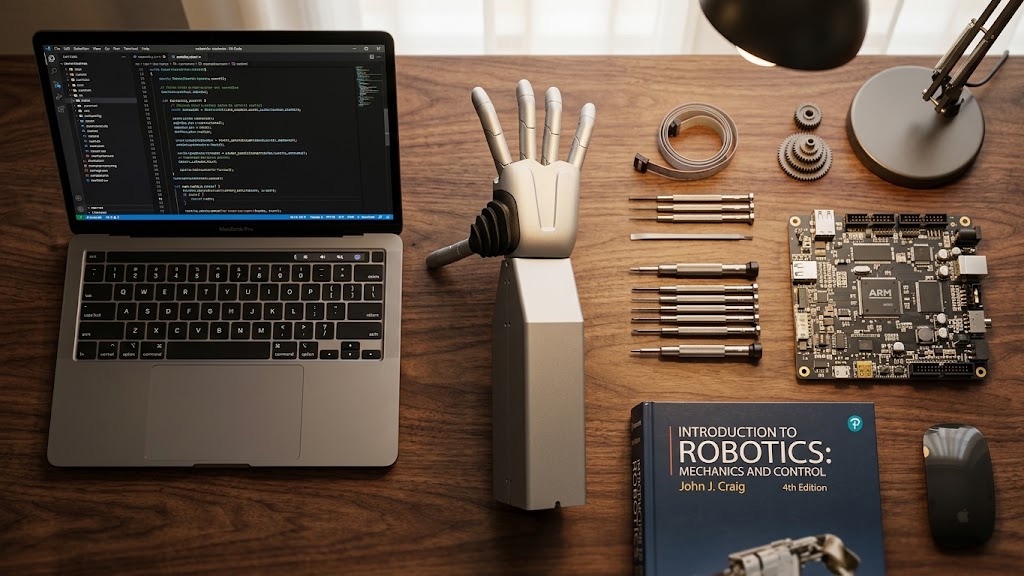
HARDWARE · SOFTWARE · CURRICULUM
No more disconnect between hardware, software, and lesson plans in traditional university labs. Devices, toolchains, and curriculum are designed around the same competency goals — less re-integration, less trial and error.
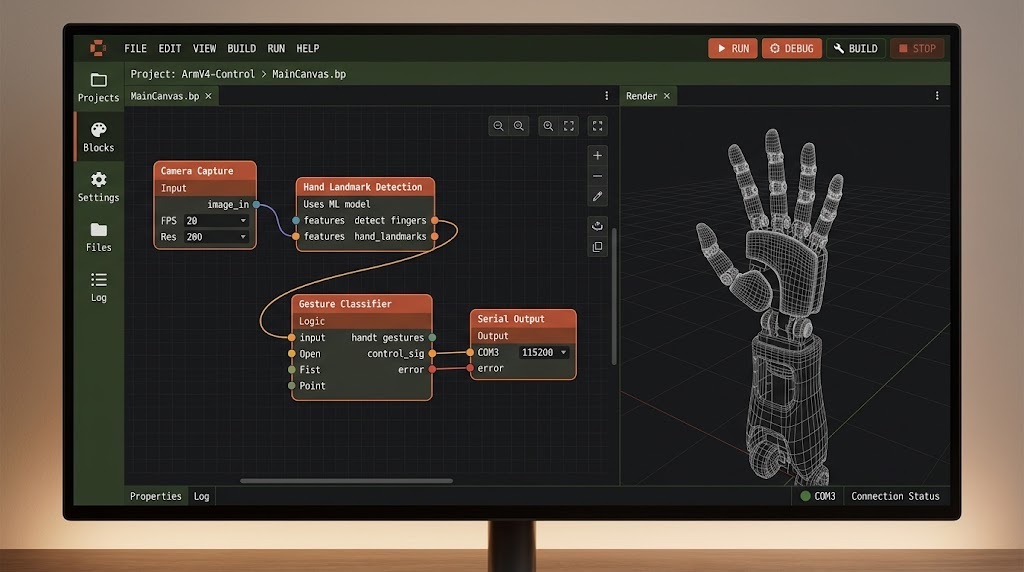
ONE LOGIC, GROWING DEPTH
From dragging virtual sliders and recording motions to reading joint data, mapping hand skeletons, and planning trajectories, learners keep advancing within the same control model.
THREE-STAGE CURRICULUM
Course difficulty rises in step with hardware capability — every stage ends in a finished project and opens a clear door to the next.
Assemble the mechanics, wire the electronics, and run button-triggered motions and basic gestures while learning about joints, actuators, and feedback loops.
Use Blockly to design motion sequences, conditional logic, and compound tasks — validated in 3D simulation.
Use Python/C++, ROS2, and MoveIt2 for visual tracking, trajectory planning, multi-finger control, and embodied AI research.
FOUR PRACTICE STUDIOS
Spaces and courses organized around real job competencies, so assembly, development, data, and models are no longer isolated modules.
Mechanical assembly standards, electrical wiring, serial-bus diagnostics, device commissioning, and troubleshooting.
Trajectory planning, ROS2 programming, machine-vision feedback, and hand-eye coordination applications.
Teleoperation trajectory recording, motion data capture, data cleaning, quality checks, and annotation.
Multimodal VLM integration, end-to-end joint control, policy fine-tuning, and deployment on real hardware.
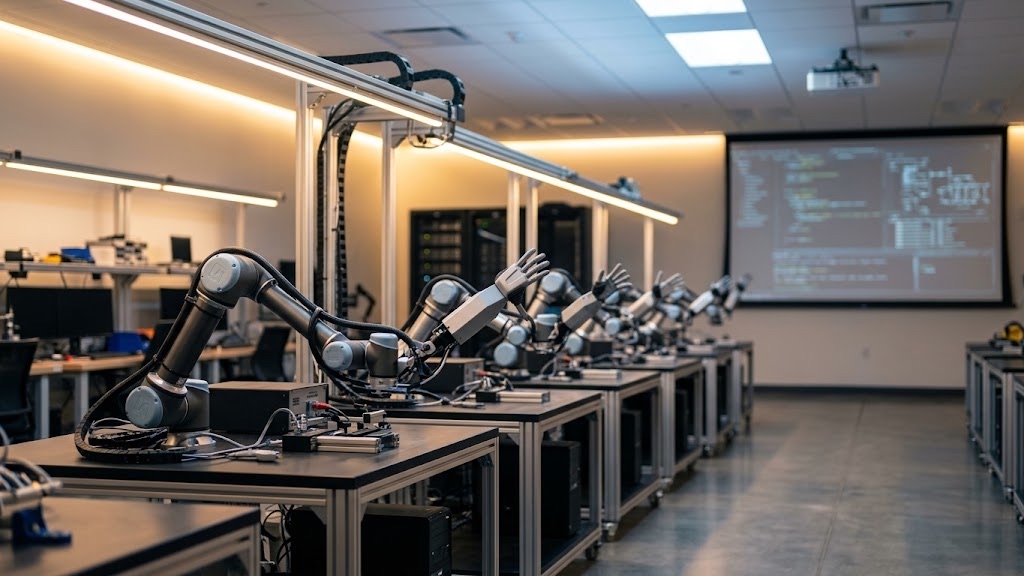
LAB DELIVERY
We deliver more than equipment — a ready-to-teach space, curriculum, and services, including a 40 m² smart classroom, a 10 m² teaching demo area, and 12 dual workstations.
From a single course lab to a full embodied AI training facility, HeymanDex tailors the solution to your discipline, class size, and research goals.

Scan with WeChat
Follow HeymanDex